
Getting La Salle County Court Records
District and county records in La Salle County sit with Sonia Maldonado, the County/District Clerk. Her office holds district criminal, civil, family, and juvenile files, plus county criminal, civil, juvenile, and probate cases. Public 81st/218th PDFs and re:SearchTX can help you spot a matter. Neither replaces the clerk's actual file. The county offers no general search portal or public terminal.
- Identify the court level, case type, case number if known, and date range.
- Check re:SearchTX or the 81st/218th PDFs when electronic discovery can narrow the request.
- Contact the County/District Clerk in person, by phone, email, fax, or mail for a district or county file.
- Contact the exact JP or municipal clerk for its own record, or PACER for federal court.
- Name the document, paper or electronic format, and certification need, then approve the quoted fee.
Visit the clerk at 101 Courthouse Square #107, Cotulla, Texas 78014. Call (830) 483-5120, fax (830) 483-5100, or email sonia.maldonado@co.la-salle.tx.us. Hours run Monday through Thursday. Those days are 7:30 a.m. to noon and 1:00 to 5:00 p.m. Friday is 8:00 a.m. to 2:00 p.m. Check current county notices before you drive over.
The La Salle County Combined Clerk Route
Because of how the county's population is structured, one elected official holds both jobs. That official handles county-clerk and district-clerk duties. It makes the first call easier. It does not merge the courts themselves. County Court sits in Suite 105. It has its own phone, while the records office is Suite 107. A JP citation stays with its precinct. A Cotulla or Encinal ordinance case stays with that city's municipal clerk.
La Salle County/District Clerk
101 Courthouse Square #107
Cotulla, TX 78014
(830) 483-5120
When you contact the office, give enough detail to separate district felony, district civil or family, county misdemeanor, probate, and juvenile material. One quick question can save you a trip. Ask first which office owns the file, since a broad request often lands at the wrong counter.
Court Record Types
Record type determines both the keeper and what a copy proves. The clerk's categories cover district criminal, civil, family, and juvenile cases. County matters include criminal, civil, probate, and juvenile files.
- Docket sheets and hearing-setting entries
- Pleadings, motions, answers, and other filed papers
- Signed orders, judgments, and disposition documents
- Probate filings maintained through the county-clerk function
- Certified or noncertified copies of eligible public documents
Justice courts keep their own traffic, fine-only misdemeanor, and small-civil files. Municipal clerks hold city ordinance and Class C matters. Child Protection Court runs a separate date docket, and federal files belong to the Southern District of Texas and PACER.
Public PDF vs La Salle County Case File
The district court's general-information page states things plainly. Its website carries no pleadings or case-specific detail. A PDF can still give you a lot. Look for docket number, style, time, filed date, case age, case type, docket set, and setting comment. What it may lack is document images, a payment ledger, exhibits, or a final disposition. The 81st/218th general-information page spells out that boundary.
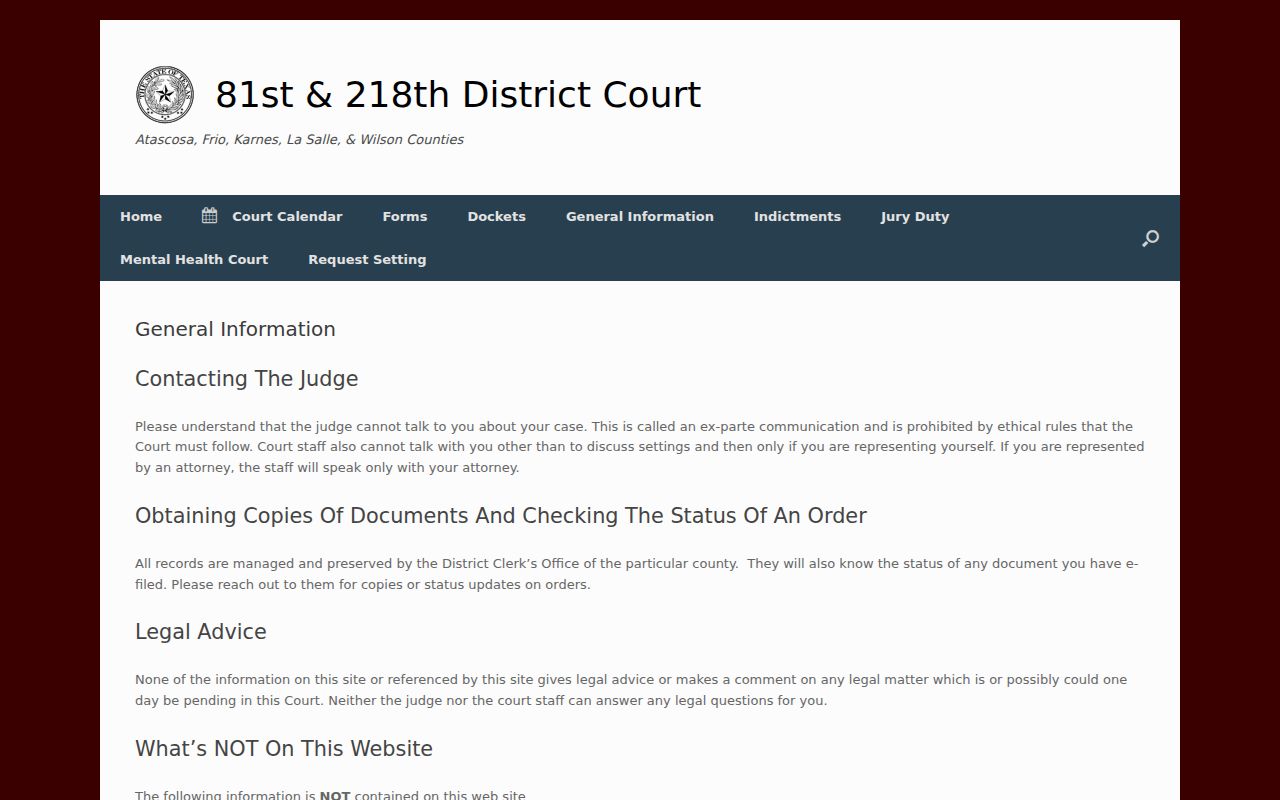
A dated docket entry is only a lead for your search. The filed court record itself comes from the County/District Clerk.
Inside a La Salle County Court Record
A full case file can reach beyond the public schedule. What's inside depends on what was filed, access limits, and the item you request. So name the documents you want instead of assuming "the record" means one standard packet.
| Case Number | The court’s identifier, shown as Docket No. in district PDFs. |
|---|---|
| Pleadings | Petitions, motions, answers, and other filed papers when public. |
| Orders and Judgments | Signed court actions, distinct from a scheduled setting. |
| Docket | A chronological or calendar record of events and settings. |
| Case Classification | Criminal, civil, family, juvenile, probate, or another category. |
| Certification | The clerk’s certificate and seal authenticating a copy. |
A civil sample's "reason set" and "setting comment" are summaries, not the motion or order behind the event. A criminal trial listing with no disposition field proves nothing about the outcome. Read each entry for what it actually says.
Rule 12 and La Salle County GovQA
Texas keeps judicial records separate from ordinary county administrative information. The Office of Court Administration access policy explains the split. Rule of Judicial Administration 12 governs judicial records. Texas Government Code section 552.0035 keeps the judiciary outside the Public Information Act's usual route. Other statutes can also control case records. So can common law and court rules.
La Salle County's GovQA portal handles county public-information requests. It does not replace asking the clerk for an adjudicative case file. Rule 12 generally requires a decision within its maximum 14-day framework. An appeal to OCA is allowed within 30 days. That right comes under Rule 12.9. Describe the judicial record precisely, so the office can actually find it.
Use the right rule: Send administrative county information through GovQA. Send a court case document request to the clerk that maintains the case.
Fees and Certified Copies
A plain copy just reproduces an eligible public document. A certified copy adds the clerk's authentication. Texas Government Code section 51.3033 sets statutory district-clerk baselines, but the county-linked 2022 cost PDF may not reflect current charges. Confirm the total, delivery cost, payment method, and certification wording with the clerk.
| Item | Statutory baseline | Request note |
|---|---|---|
| Noncertified paper copy | $1 per page | Confirm local total |
| Certified paper copy | $5 certificate/seal plus $1 per page | State certification need |
| Electronic document | $1 through 10 pages, then $0.10 per page | Where statutory rule applies |
| Search without docket number | $5 | Supply an exact number if known |
| Abstract of judgment | $8 | Ask whether this is the required item |
re:SearchTX sometimes lets you buy documents through a cart. Check its current price in the portal, and keep those charges separate from clerk fees and federal PACER costs.
Older La Salle County Court Record Strategy
Older or nonelectronic cases can be absent from the web. The clerk may still hold them. Start with the court level, case type, and approximate filing period. Add a name or estate identifier where lawful. You can also add any docket number from an old notice. Ask whether the item is paper, electronic, microfilm, or archived another way. Ask too whether extra search time adds cost.
The county makes no promised turnaround for archives and offers no public terminal. Call or email before mailing payment. That way the clerk can confirm custody, page count, format, redactions, and the current charge. For federal historical material, use PACER and the federal clerk instead of the county office.
Sealed Records and Public Access
Texas Rule of Civil Procedure 76a starts from the premise that court records are open. Sealing one takes more than a wish. The rule demands a motion, notice, and a hearing. It also asks for a stated interest that clears its standards. Rule 21c adds its own layer of protection. It requires careful treatment of sensitive data such as identification numbers, account details, birth dates, home addresses, and the names of minors. Statutes and standing orders pile on further limits. Those cover juvenile cases, expunged and nondisclosed matters, and child-protection files.
So a La Salle County docket entry you pull up may look thin. It could be redacted, partly visible, or missing from online view entirely. Absence does not mean no case exists. A requester who wants more than the public copy must use the court's lawful procedure. No case number, however accurate, lets the clerk hand over a sealed record.
Key access sources: Rule 76a addresses civil sealing, Rule 21c addresses sensitive data, and Rule 12 governs many judicial-record requests.
La Salle County Request Details That Help
The more precise your request, the faster the clerk can move. Say upfront which court holds the matter. That could be district court, constitutional county court, a JP court, municipal court, child-protection court, or federal court. Then add the case category and the docket number. Include the filing or hearing period, the document title, your preferred format, and whether you need a certified copy. Give contact information. Ask for a fee quote before anything is processed.
Hold back sensitive identifiers unless the clerk confirms they are legally required. Then send them only through a secure route. A public docket number paired with a date usually works better as a search key. If your request lands in the wrong office, ask which named office actually keeps the record. There is no point mailing the same broad wording to everyone.